One Missing Word Doesn't Tell You Why.
A free 4-part morning routine that logs the kind of lapse, not just the fact of it — so in a month you have a real record instead of a worry. From a physician.

You lose a word in a meeting. You cover it, the conversation moves on, and no one seems to notice. Then you get home, and hours later you're still turning it over — assembling a case against yourself out of two or three isolated moments.
Reaching for a word that doesn't arrive on schedule is one of the most common health worries there is. The thoughts that travel with it:
- “I walked into a room and completely forgot why I went in.”
- “I re-read the same email three times and it still didn't land.”
- “I used to be the fastest person in the room, and now I write everything down twice.”
- And underneath, almost in a whisper: “Is this normal, or is something wrong?”
The people most frightened by this tend to be the sharpest — the ones with the most exact sense of what their own mind used to do. That's precisely why a small slip can feel like evidence of something larger.
Before We Start, I Want You to Know Something
The fear you may be carrying — the one you might not have said aloud — is far more common than the thing it fears, and it is usually louder than the facts warrant. Reaching for a word that comes a beat late is one of the most frequent concerns people bring to a physician, and one of the most frequently misread by the person experiencing it.
It is also not a failure of effort or will. Concentrating harder is not a treatment, and lying awake reproaching yourself is not a diagnostic step.
Why the Usual Fixes Leave You Where You Started
Most people try at least two of these before anything else.
- Brain-training apps and puzzle streaks. They improve performance on that specific task. If what changed is not a skill you stopped practicing, more repetitions rarely transfer.
- Another coffee, or a stronger cup. Caffeine can borrow an hour of alertness and return a slump later. It redistributes the problem; it does not resolve it.
- A single-ingredient “brain-health” capsule. Usually selected from the label, with nothing built around it. On its own it rarely does much.
A Missed Word Is Data. It Is Not a Verdict.
Here is the careful version. A single episode — or a handful over months — does not establish a cause. Word-finding lapses have a long list of possible contributors: sleep loss, sustained stress, cognitive overload, perimenopause and menopause, thyroid problems, low B12, certain medications, low mood — several of which a physician can check directly. One missed word is not enough to answer the question you're afraid to ask. The goal here is to notice your own pattern rather than predict it for you — because a month of specific notes is worth far more than an impression.
This is a place to start observing, not a diagnosis. If the change is new, clearly different from your baseline, getting worse over weeks to months, or affecting how you function day to day, take it to your doctor — and sooner if something worries you.
The Clear Routine: 4 Steps, and a Record Worth Keeping
These cost nothing and need no prescription. About four minutes of doing, plus a few seconds of noting through the day. It is built to produce a useful record — the kind you could hand a clinician — not to “train” anything. Leave out any step that doesn't suit you.
That is the routine. Repeat it tomorrow — keeping it on the difficult days too is what makes the record worth reading.

The routine fits on one card and the log fits in a pocket notebook. A record is useful when it is simple enough to keep without negotiating with yourself.
What This Actually Looks Like
I am not going to tell you what will happen. Here is what the record gives you:
A Routine and a Log Only Reach So Far
I will be as direct here as I would be in a consultation: the four steps are worth doing every morning. They steady the start and they build the record. What they do not do is carry the afternoon — by early afternoon the scattered feeling often returns, regardless of how the morning went. That is the gap the next part addresses.
Where MemoFlow Fits
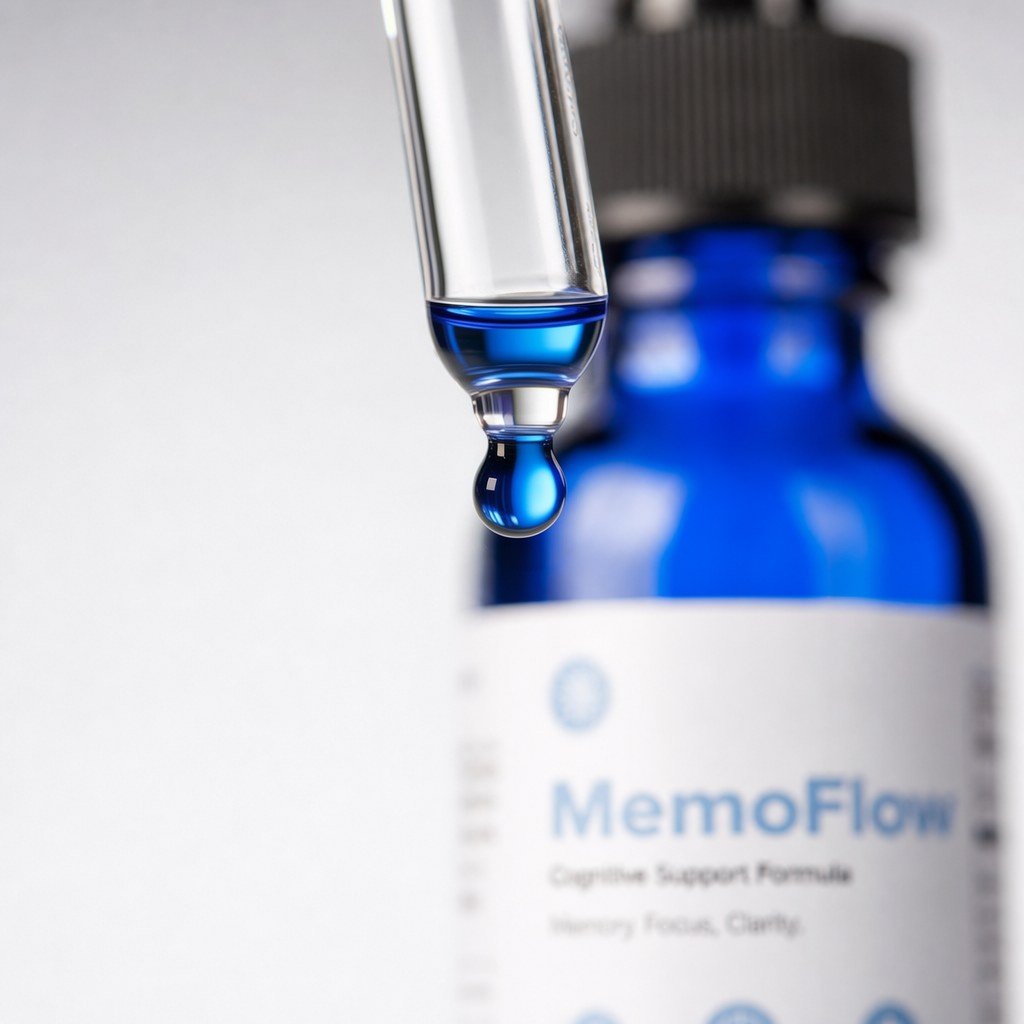
For myself, alongside the routine, I take MemoFlow — two drops under the tongue each morning. It is a dietary supplement for everyday memory, focus and clarity, formulated to:
- Help maintain a clear mind*
- Support focus and concentration*
- Support memory and clarity*
Why This, and Not Two Bottles From a Health-Food Store
Evaluate it the way you would evaluate any claim: what is in it, in what amounts, and made where.
- Two naturally-sourced actives in a fixed ratio — anthocyanins from Ikarian mountain honey and natural lithium orotate. Ordinary honey does not carry that concentration, and either component on its own is only half the design.
- Neural MicroLock™ delivery — a micromilling process that concentrates the compounds into particles fine enough for sublingual absorption rather than a capsule the body has to break down.
- Naturally-sourced actives and nothing else — no stimulants, hormones, drugs or artificial dyes.
- Made in the USA in an FDA-registered, GMP-certified facility, batch-tested before release. Sold direct, because a naturally-sourced formula degrades with poor handling and counterfeits are common in this category.
Assembling the same combination yourself means guessing at two doses and two forms. This is the version that is already specified.
Buy 3 bottles, get 3 free
$19.99 $100 80% off a bottle
- 6 bottles — a full 6-month supply. A fair span to assess it over, rather than stopping partway.
- Two drops under the tongue each morning — the entire routine.
- 90-day money-back guarantee. Contact the company within 90 days for a full refund — even empty bottles, no return needed.
Today's offer on the product page — availability and terms can change.
90 days to weigh it and decide for yourself
Who This Is NOT For
- Anyone expecting this resolved overnight. The contributing factors respond to consistent inputs over weeks, not to a single dose.
- Anyone unwilling to keep the routine for a fair stretch. It need not be flawless. It does need an honest trial.
- Anyone with new, clearly progressive, or function-affecting changes. That warrants a proper assessment first, and this should not delay it.
Two Paths From Here
A few months from now, you will be living one of these.
Keep managing it privately
You close this guide. Perhaps the routine lasts a few mornings. The afternoon fog keeps returning, the blanks keep happening, and you keep telling yourself you will raise it at the next appointment — with nothing written down to raise.
Run the routine and trial the drops together
You keep the routine and trial MemoFlow with it, keeping the log. Give it a fair 90 days and judge your own experience — if it did not earn a place in your morning, the company refunds you, and the risk stays with them.
80% off today · 90 days to change your mind, empty bottles included
“The word that wouldn't come in that meeting is still in my notes, with the date. That is the right place for it — not turning over in the dark at two in the morning.”
Dr. Eleanor Vance, MD Physician · Beacon Hill, Boston